Tuesday, 9 February 2010

The Rain in Spain ...


It doesn't rain, it pours. And for the past four and a bit months it has been pouring. And when it pours I do not get to see any theatre. And when I do not see any theatre, this blog goes through a giant drought.

Well that's not total truth, I did see Chicago just before Gina Riley left. Never did I think that such a bare and simple staging of a show could entertain so well. Brilliant, the whole cast (especially Caroline O'Connor, Sharon Millerchip, Gina Riley and D.C. Harlock) knew how to put on a show. Tight knit, saucy and incredibly enjoyable.

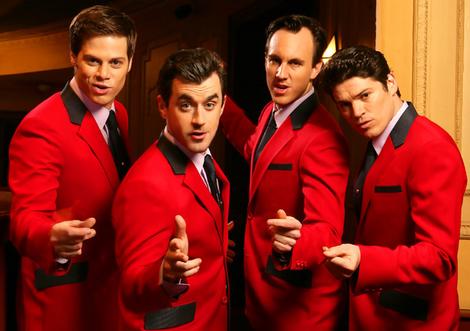
I was very spoilt and given tickets to Jersey Boys as an early Christmas gift. However many times I said 'oh no you shouldn't have', I am really glad they did as I wasn't going to go otherwise. The show is completely different from anything you have seen before. It breaks the traditional Broadway Musical genre (as more and more shows these days are), bringing in a live-action documentary theme. Songs aren't sung from the heart but rather as recreations, actors perform with their back to the audiences, scenes fly in and out with very little potency and impressive sets are seen for a matter of minutes but when combined together what the audience receive are a flashy presentation on the life of the Four Seasons. The cast are excellent in their portrayals of their characters (with special mentions to Bobby Fox as Franki Valli and Stephen Mahy as Bob Gaudio) as well as the other cameos they must take on. The cast consists of 20-something guys but only four ladies who change from mothers to wives, groupies to back up singers. I urge everyone to go see this show whatever age or level of Four Seasons fan you are. I went with my Nanna, an 18 and 80 year old, and we both loved it.
In other news, I have just received subscriptions for the Melbourne Theatre Company 2010 Season in which I will be seeing eight plays, and for the Malthouse Theatre Company Season 1 (of 2) which will consist of five plays. I have promised myself (which doesn't always mean they will be kept) that I will review or at least comment on each play, despite often seeing them mid-way through a season (in Journalism Ethics we learn about news-worthiness, and anything a few weeks late isn't worth spending time on, so this is mainly just good practice).

I then will hopefully be attending some of the big blockbuster musicals heading Melbourne's way. Mary Poppins is top of that list, closely followed by West Side Story and then Cats. I have sort of been guilt-tripped into seeing Cats because I "cannot be called a theatre-lover without seeing that masterpiece". Mammia Mia and Fame will be missed for the health of my budget and possibly my impeccable taste *insert pretentious chuckle here*.

I have returned to this blog just in time as my theatre-viewing year starts tomorrow with MTC's production of The Drowsy Chaperone which has been playing to rave reviews. I nearly missed out on tickets (I submitted my subscription too late) so will be conversing with the God's at the back of the balcony. Oh well, shall be fun.

Just as a side note: I am also in the process of sorting out ways to extend this blog's niche. While theatre and the performing arts is one of my biggest hobbies, or dare I say it, passions, I believe that I am also missing out on rambling about other aspects I enjoy: films, TV shows, music and books amongst others. The term 'audience' is not simply reserved for theatre vernacular and relates to all these different mediums and more. Even fashion has it's 'intended audience'. So I will be fiddling about with the layout and such to make this blog a bit more diverse, not only so that I can practice writing in other areas, but also have a bit more fun writing about others things without starting an entirely separate blog.

That is all for now, I hope.

ramblingdaniel
(yep, that's my official blog pen-name).

Wednesday, 2 September 2009

Review: 'Jack O’Hagan’s Humdingers' – Malvern Theatre Company


Malvern Theatre Company’s fantastic Victorian Premiere of Jack O’Hagan’s Humdingers is a nostalgic, patriotic, touching and comedic look at 20th Century Australia from the eyes of a prolific Australian songwriter and his family.

The musical itself adopts a vaudevillian style, dashing from decade to decade of Australian history. O’Hagan’s songs are uplifting and well ordered within the plot, while the small cast of six provides a homely atmosphere to the show. This blend of features causes the experience of watching the production to feel like you are sitting around the piano or radio with your family in the early 1950s.

The cast worked sensationally together, transforming character with ease and fluidity. With no evidence of opening night nerves, in both song and dance they were perfectly synchronised, giving the impression of a professional quality cast.

Barry Baker as Jack O’Hagan performed with confidence and a deep understanding of his character. Gabrielle O’Brien as his wife, Josie, was terrific in her ability to portray both sincere and comedic moments effortlessly. Her portrayal of Ethelind Terry, the lead actor in O’Hagan’s operetta Flame of Desire was outstanding as were her solos ‘My Public Waits For Me’ and ‘One Little Kiss in the Moonlight’.

The comedic Ian Frost and cute Angeline Thompson performed strongly in every one of their portrayed roles. Often partnered together, their believable chemistry and excellent comedic skills supported each other. This was especially evident in the roles of Buddy and ‘Lana’ in the recreation of O’Hagan’s proposed movie musical, A Kiss Down Under, as well as their caricatures of early film theatre ushers.

Daniel Mottau and Laura Slavin were the absolute standouts of this high quality cast. Mottau commanded the stage with high energy and enthusiasm. His use of head voice, most notably in ‘Boy Up North’, was strong and very reminiscent of that used in the harmonies of Frankie Valli and the Four Seasons. Slavin was also very impressive with an utterly brilliant voice. Her solo ‘Little Ships Will Sail Again’ was touching and heartfelt while her rendition of ‘Start The Day Off With A Smile’ as a Shirley Temple look-a-like was absolutely hilarious.
Alan Burrows’ direction revealed a unique and strong vision, which greatly supported the success of the cast’s confidence and ability. The choreography effectively reflected the dance styles of the respective eras though became a bit overworked and ‘corny’ by the show’s conclusion.

Together, Colin Prohasky and Musical Director, Shirley White presented a simple but effective score. Prohasky was responsible for rewriting Humdingers for multiple keyboards and this successfully added a much richer sound to the performance.
The set design, by David Dare, was spectacular in recreating a big band atmosphere, perfect for the vaudevillian nature of the show. The black and white theme also allowed for David Earl’s lighting design to emphasise the transitions in place and time. Finally, Dina Mac Namara’s costume designs were fantastic. From the costumes used in the operetta, Flame of Desire, to the Red Cross nurses’ showbiz-style outfits, an attention to detail and care was highly evident.

With hits such as ‘Our Don Bradman’, ‘Dog on the Tuckerbox’ and ‘Along the Road to Gundagai’, the opening night audience of Jack O’Hagan’s Humdingers had a fantastic time and there is no reason you should not too.


This review can also be viewed at theatrepeople.com.au

Friday, 21 August 2009

Review: 'Macbeth' - Eagle's Nest Theatre Company


Eagle’s Nest Theatre Company’s latest production of Macbeth has been advertised as, “Shakespeare as it should be – no frills, plenty of thrills & chills.” This is exactly the approach that the company has adopted, performing Macbeth as it may have been in the early 17th century.

This traditional approach allowed the audience to reflect on the characters’ journey into inner conflict and, in some cases madness, rather than on the regal costumes, dazzling effects and modern adaptations that are seen in many contemporary Shakespeare productions.

Most of the acting performances demonstrated a strong knowledge of the text and of Shakespearean verse. Jason Cavanagh as the title role was a stand out, creating a completely three-dimensional characterisation of the tragic king. Elizabeth Slattery gave a fantastic performance as Lady Macbeth, revealing the dark motivations of her character that eventually lead to her absolute derangement.

As always with productions of Macbeth, the three witches were an exciting breath of fresh air. Kendy Gable, Poppy Tremayne and Stephanie Evison-Williams portrayed each ‘weird sister’ with their own individual nuance. Poppy Tremayne also appeared as the role of Lady Macduff, a scene of intense emotion that is often overplayed. Her performance in this short scene was excellent and it was disappointing that her talents were limited to only few scenes.

The whole cast worked well as an ensemble, giving the impression that the onstage relationships were comfortable and real. This was especially evident in the chemistry between Cavanagh and Slattery, as Macbeth and his wife, and the unnerving bond between the three witches.

Sean Kavanagh’s direction definitely supported the actors’ performances. Scenes were mostly blocked appropriately so that a large number of people were positioned carefully on the small performance space, although occasionally someone’s lines were recited from behind another actor. Also, the idea to have the witches transform the set between each scene reinforced their power and influence over the play’s action.

Despite the already basic staging, an even more minimalist approach could have benefited the production. Robbie Lingham’s set consisted of cardboard structures in the shape of castle walls, towers and forests. These often distracted from the performance and caused scene transitions to be slowed down. The opening of Act IV involved a bare stage except for the witches’ cauldron, which allowed a much-improved focus on the story line and the actors. The costumes were strong in some areas, for example the witches’, Porter’s and regal costumes but were undermined by other anachronistic costumes, for example tweed coats, dresses and high heels that resembled the fashion of the 1950s.

The lighting design was very effective in conveying different locations and moods. The use of a red spotlight was successful in distinguishing characters’ soliloquies from the rest of the dialogue. A brilliant soundscape was presented by Daniel Nixon, which heightened the tone and emotions of the scene. However, the contemporary scene transition music was somewhat distracting even with some links to their preceding scenes being evident.

Despite this, Eagle’s Nest Theatre Company’s production of Macbeth was upheld by dedicated and endearing performances, which allowed the genuine strength of Shakespeare’s original psychological tragedy to shine through.

This review can also be viewed at theatrepeople.com.au

Saturday, 1 August 2009

Review: 'Melbourne Boys' - CEL Productions


JC La Fontaine’s new stage production Melbourne Boys infuses common clichés and previous experience to form a modern Melbourne coming-of-age story.

Written as a series of vignettes, Melbourne Boys reveals the story of Sebastian and his friends’ final year at secondary school, portraying the stress and experiences of VCE as well as the challenges of an everyday teen life.

The play is fairly successful in its attempt to transform regular high-school stereotypes into three-dimensional characters. Common school ground personalities such as the ‘rich bad-boy’ are well developed whereas other more comic clichés such as the ‘choir nerd’ or ‘giggling school girl’ appropriately remain untouched.

While a collection of vignettes may be a strange choice for presenting a dramatic plot, Christine Husband’s direction ensures the small episodes move quickly and fluently so that tension and timing are not lost within the non-naturalistic scene transitions.

The language and scenarios contained within Melbourne Boys reflect and portray a life-like atmosphere, which provides an engaging reality to the play. However, with the sudden inclusion of quite dramatic conflicts toward the end of the play’s action, a slightly ‘soap opera-esque’ tone is adopted, disappointingly interrupting the more realistic nature of the performance. This could perhaps be solved by allocating more time to the introduction and resolution of the eventual climax of the play.

The cast worked well with their given material, in most cases forming credible characterisations. Liam Tapper performed strongly in the role of David, Sebastian’s economically disadvantaged friend, especially in times of greater tension. This was a contrast from Benjamin Stokes who provided much needed comic relief as the class ‘geek’. JC La Fontaine and Sam Young convincingly developed the characters of Sebastian and Billy respectively, although tended to appear melodramatic in the concluding scenes. This may have been caused by opening night nerves or by an uncertainty with the script’s reasonably sincere themes.

The chemistry between Chloe Gavin and Tom Clifas, portraying the roles of Jo and Anthony, was highly believable, an aspect that was very important to bring their short scenes to life. Patti Rocca brought a sense of truth to the role as Sebastian’s mother, causing the audience to cringe as they recognised their own embarrassing mother within her character.
The actors brought a professional touch to their work, evident in their ability to continue performing with absolute focus despite a rather interruptive audience distraction occurring mid-performance.

André Stefan White in collaboration with Fontaine’s original designs devised an economic but effective greyscale stage. The simple set pieces represented a range of differing locations without the need to move or change in appearance enhancing the non-naturalistic flow of the play. The costumes also blended with the greyscale theme allowing Christina Montgomery’s lighting designs to be used to the greatest possible benefit.

While some flaws may be evident in this, the first of JC La Fontaine’s pair of Melbourne Boys plays; it is an enthusiastic contribution to the ever-growing collection of Melbourne-based theatrical works.

This review can also be viewed at theatrepeople.com.au

Blogging Drought


Due to exams, holidays, work and other commitments there has been a major delay in blog updates. However, I am back into the swing of things and new posts should be popping up quite often.

Over this blogging drought I did get to see 'Avenue Q', a hit new musical which even beat 'Wicked' at the 2004 Tony Awards. The show’s programs and posters are labeled “not for kids” and that’s the basis for most of its humor. ‘Avenue Q’ is like Elmo, Oscar the Grouch, Bert and Ernie have grown up and gone on to have dead end jobs and seemingly bland lives. The Australian cast was fantastic and the updated sets and lines added a fresh new feel to the show.

I have just reviewed CEL's production of a new amateur Melbourne work 'Melbourne Boys'. I will post it soon.

Monday, 8 June 2009

Geoffrey Rush: The King of All Broadway


Congratulations to Australian actor, Geoffrey Rush who has just won the Tony Award for the "Best Performance by a Leading Actor in a Play" as King Berenger in 'Exit the King'.

'Exit the King' premiered at Melbourne's very own Malthouse Theatre.

For all other Tony Award 2009 news click here.

Sunday, 7 June 2009

Review: 'Blood Wedding' – MUST


Blood Wedding is a difficult play to produce. It is surreal, poetic and contains aspects of song and rhythm that often cannot be reproduced in performance as once desired by Spanish playwright, Federico Garcia Lorca. However, Monash University Student Theatre’s production of Blood Wedding or Bodas de Sangre is an inventive, experimental and thoroughly researched production that effectively achieves the original sense of musicality of the play.


The Monash University Student Theatre space is much like many smaller production’s spaces: a black, square room that acts as the stage, the seating area and the foyer. Often you walk into these theatres fearing a bland, low budget piece of so-called ‘experimental theatre’. Having said that, this was not my first visit to the MUST headquarters and after seeing their production of Burgess’ A Clockwork Orange I had high expectations for this production. I was not disappointed.

Visually, director and set conception designer, Celeste Macleod, has captured the essence of Lorca’s surrealist staging. Basic, abstracted set pieces reveal an entirely new setting while lighting enhances the mood of the various scenes. The small space and reduced audience size heightens the tension of the performance, a very important aspect in Blood Wedding. However, the small stage often seemed overly crowded despite having only a maximum of twelve actors on stage which became distracting, especially in the wedding party scene in which it was hard to separate the important action with the background dancing.

The cast performed with an enthusiastic energy that relayed a passion for their performance and adaptation. Sarah Walker, as the Mother, and Lili Andrews, as the Bride, were both excellent in conveying a sense of absolute passion, which is one of the play’s key motives. Their characterisation was incredibly detailed and carefully specific which paid off in the final scene, which is played out at an extreme level of emotional intensity. Sara Downs, who played a variety of characters including the servant and the Beggar Woman, was probably the strongest member of the cast, evident in her ability to transform character so rapidly and effectively. As the servant she was a fun-loving, energetic character hustling and busting around the stage. This was a complete contrast from the passive but eerily intimidating Beggar Woman who is indeed death in disguise.

Charles Leong’s sly and playful characterisation of the Moon was interesting and appropriate to the Moon’s malicious need for blood. Despite this Leong sometimes seemed to menacingly laugh at his character rather than as his character, a trait that caused the scene to become almost comedic instead of horrifyingly spine-chilling.  This difficulty in portraying such extreme emotion was evident in other characterisations, for example Phillip Rouse’s character, Leonardo. Leonardo is a powerful, domineering man and many of his scenes require intense conflicts. Rouse, sometimes dropped character (or even picked up an American accent) in these situations.

One of the most impressive features of MUST’s production of Blood Wedding is the use of music. Composers Kate Alexander and Tom Wolfe provide a hauntingly beautiful soundscape that I am sure would impress Lorca himself. The music creates the impression of a thoroughly modern production that is still in contact with its Spanish origins while assisting the actors in their songs and rhymes that are weaved throughout Lorca’s play. This is effectively achieved without becoming overly prominent or distracting in the production.  

Monash University Student Theatre’s Blood Wedding is a fresh, modern adaptation of Lorca’s rarely produced text and despite some minor flaws is indeed an interesting analysis of love in our contemporary society.